Showing posts with label Pastry. Show all posts

Thursday, December 3, 2009

St. Nicholas: My Favorite Saint


December 6 is the feast of St. Nicholas – my favorite saint. In Europe, Christmas is still considered a religious holiday, and the Feast of St. Nicholas is the day for fun and presents (although that is changing somewhat).

The generous Greek bishop comes to the aid of dowerless damsels, children, sailors, fishermen, the wrongly imprisoned and darn near anybody else who needs his help. No wonder everybody wants to throw him a party!

St. Nicholas is recognized and celebrated all over Europe. He is particularly popular in the Dalmatian region of Croatia where he is known as Sveti Nikola. You can’t walk around the block there without running into a church named after him.

Biloxi’s Dalmatian immigrants brought St. Nicholas with them to help look after their fishing boats. He performed the job admirably from his perch outside the Slavic Benevolent Association's lodge on Point Cadet until Hurricane Katrina knocked him over.

Growing up we celebrated St. Nicholas' Day and also St. Lucy’s feast day on December 13th. My mother explained that St. Nick was Santa Claus’s older, skinnier cousin. Actually, they are one and the same, but I still think of St. Nick as the "skinny cousin." Don't we all have one?

In Europe, St.Nicholas leaves children toys, candy and fruit in their shoes, stockings, or a special “St. Nicholas sack.” In our house, St. Nicholas always left our trinkets knotted on a long string.

Maybe Nona used strings as a hygienic alternative to putting food in shoes that her six kids wore (kind of gross when you think about it). She sure couldn’t afford to buy them all a “ceremonial” pair of shoes. Since several other Biloxi families also used strings, I’m inclined to think it might have been a local custom peculiar to the region they came from.

Compared to the bounty Santa Claus left at our house, his skinny cousin’s offerings were comparatively lean – but altogether magical.

Our average Nicholas string included several pieces of imported candy (my favorites were the foil-wrapped cordial-filled chocolates shaped like wine bottles), a sack of chocolate gold-foil wrapped coins (in honor of the gold coins St. Nick left for the dowerless maidens), a folk-y Christmas ornament, a flavored popcorn ball and always, ALWAYS a shiny red apple at the bottom of the string.

Apples have a symbolic association with St. Nicholas. Apple strudel is a common St. Nicholas Day treat. In old Croatia, this was a traditional day for engagements with the young man presenting a basket of apples to his intended as he popped the question. It all goes back to those three dowerless virgins. The gold St. Nick left for them is often symbolized by three gold balls, which in some paintings and statues, are depicted as apples.

As Biloxi’s Croatian families assimilated into American culture, a lot of them forsook celebrating St. Nicholas Day and rolled all their celebration over to Christmas. Sadly a number of my generation and the next never knew the joy of awakening to a Nicholas string on December 6. What a pity.

If you’d like to find out more about St. Nicholas and start a tradition of your own, I suggest you visit this site. It is an incredibly comprehensive source of St. Nicholas info. You can even find out what he really might have looked like.

And how seriously cool is it that there is an entire non-profit organization (in Michigan of all places) dedicated to promoting awareness of my favorite saint?

Photo: I ordered this ornament from the St. Nicholas Center for my Christmas tree and one just like it for my niece's Nicholas string. Their site has all kinds of great ornaments, stamps, cookie cutters, stickers, that make perfect items for Nicholas strings, stocking/shoe/sack stuffers. The site also posts some traditional recipes from the countries that celebrate this feast day.

The two recipes below are from my family's celebration.

Enjoy and have a Happy St. Nicholas Day!

JELLO POPCORN BALLS – A NICHOLAS STRING STAPLE

The popcorn balls that graced our Nicholas strings mostly came from the Karmel Korn shop at Edgewater Mall in Biloxi, but occasionally we got these made-from-scratch popcorn balls. The Jello (lime or cherry) not only makes the balls flavorful, but festive, too, although the cherry ones usually turn out more dark pink than red.


1 cup light corn syrup
¾ cup sugar
1, 3 oz. package of Jello (cherry or lime are preferred)
2 ½ quarts of popcorn, popped


Boil corn syrup, sugar together. Add the Jello. Stir until dissolved. Remove from heat . Cool slightly. Add popcorn. Grease hands. Shape mixture into balls, working quickly. Let dry. Makes about a dozen depending on how large you make them.


APPLE STRUDEL

Nona and Aunt Dolores were famous for their apple strudel. They always made it this time of year. Now that they're both gone, my cousin Steve makes it now.

Pastry Dough:

2 eggs, well beaten
½ stick melted butter
1 teaspoon vanilla
½ cup granulated sugar
3-4 cups of flour (1/2 cup self-rising to 2/3 cup of all-purpose).


For the dough: Mix first 4 ingredients together in a large bowl with electric mixer. Add flour gradually. Dough will get very stiff (add more if needed). After mixing, knead dough on a surface lightly dusted with all purpose flour. When the dough feels smooth, poke your finger in it. If the indentation fills back up quickly, it is time to roll the dough out.

Transfer dough to a lightly floured clean dishcloth. Roll dough out in a circular shape for one big roll. May also separate and roll into two circles (on separate cloths) to make two smaller rolls. Keep the dough thin but not too thin. You don’t want the apples to pierce through the crust and let all your good juices escape.


Apple Filling:


7-8 large red apples, thinly sliced
½ stick of butter, cut into pats
½ cup granulated sugar
½ cup cinnamon

Apple Filling: Spread the apple slices on the dough (which is still on the cloth). Dot with butter. Sprinkle with sugar and cinnamon. You can use more or less sugar/cinnamon depending on your taste and the sweetness of the apples.

Lift cloth and roll like a jelly roll. Place seam side down on an ungreased cookie sheet with an edge. Tuck under both ends of the strudel to keep juices in.

Dot top with more butter. Sprinkle on more sugar and cinnamon. Bake in a 350 degree oven 35-45 minutes or until slightly browned. Baste 2-3 times during baking. Cool. Slice thin to serve. Makes 1 large roll or 2 small ones.

Tuesday, November 24, 2009

Celebrating My Name Day

Tomorrow is my name day. If you’re from Europe or Latin America at this point, you’re ready to buss me on both cheeks and heartily wish me a “Happy Name Day.” If you’re from here, you’re probably just thinking “Heh?”

In the Roman Catholic and Eastern Orthodox religions, “name days” are the feast days of the saints for whom you were named. Since almost every one in Catholic Europe is named for a saint (or more likely for a relative who was named for a saint), everyone has a “name day” which is celebrated with as much verve and gusto as birthdays are here. Birthdays in Europe are considered private affairs celebrated only by family and those with a “need to know.” Name days on the other hand are more public events since everyone knows your name.

If you are a Catherine/Cathy /Kate/Karen or some variation thereof, you can just about pick your name day given the numerous St. Catherines and their associated feast days on the liturgical calendar. I traditionally observe the feast of St. Catherine of Alexandria . Or did until she ran afoul of the Pope in 1969 or thereabouts. It seems the Church could not verify that she and a whole slew of other saints ever existed. So they were expunged from the calendar during a era of papal reform. And I had to start observing my name day in April on the feast of St. Catherine of Siena. It just never felt right to me. Recently, I noticed that St. Catherine of A. is still the most popular St. Catherine in Google (if not the Vatican) so I’ve reclaimed her feast day as my own. What are they gonna do? Excommunicate me?

St. Catherine of Alexandria was one of the glamorous virgin martyr saints -- reputedly as hot as she was pious and virtuous. Her beauty attracted the eye of the lecherous Roman emperor Maximinus who went along with her efforts to convert him to Christianity until he realized she wasn’t going to give him any. He ordered her tortured and executed in retaliation. If you were a woman, that was the usual path to sainthood – that or become a hermit nun who had visions. Today they would call those women bi-polar.

Catherine’s instrument of torture, a spiked wheel, mysteriously broke whenever her tormentors tried to bind her to it. Emperor Max was not impressed by this divine intervention and had her beheaded. So Catherine got to be a saint with fireworks named after her rather than tart who set off fireworks in the bedroom. She later became one of the “Fourteen Holy Helpers” the go-to saints who helped in times of adversity and difficulties. Sort of like a Catholic League of Justice. St. Catherine's specialty was intervening against sudden death. The “holy 14” were also victims of papal reform.

So how does one celebrate one’s name day? With flowers. I always got a nosegay of camellias, the South’s ubiquitous fall/winter flower. My mother also made my favorite custard-filled crème puffs – something I now know are called Princes Krafne in Croatia. And I got to eat tacos on the good china (an honor also extended on my birthday). That’s it. No presents or parties or anything like that. Just a simple little day of observance to make me feel just a touch more special than usual.

And it always did.

Cream Puffs or Princes Krafne

Pastry

1 cup milk

1/2 t salt

2/3 cup unsalted butter

1 cup plus 1 T flour (all purpose)

4 eggs

Put butter and milk in small saucepan; stir over high heat until melted. Add flour all at once and beat vigorously for two minutes. Add eggs one at a time and blend until smooth. Beat fast until smooth and fluffy.Drop by teaspoonfuls, 2 inches apart, onto ungreased cookie sheet.Place in preheated oven and bake at 350 F for 20-30 minutes. Do not open oven door while puffs are baking.Let cool. Cut off tops. Fill with custard filling. Replace tops. Sprinkle with confectioners' sugar.

Custard

4 egg yolks

4 T sugar

4 T flour

1 t vanilla
1 pint milk
4 egg whites.

Mix egg yolks, sugar, flour and a few tablespoons of cold milk. Boil remaining milk. Add egg mixture to milk and continue to cook until thick, stirring frequently. Beat egg whites until stiff. Fold into the custard. Refrigerate until thick.

Thursday, May 28, 2009

Hrstule: Don't Get Married Without Them

As we enter peak wedding season, I keep a hopeful eye on the mailbox. I love weddings. Not just for the romance and free booze, but because, if I get invited to the right wedding, I'll be able to gorge myself on hrstule. Believe me, it's well worth springing for that stem of Waterford.

Hrstule, or bow ties as they are commonly called here, are one of the more well-known Croatian pastries. Dough flavored with whiskey and anise oil or essence of anise, is rolled thin, cut in strips, tied in loose knots, fried and dusted with powdered sugar. They are commonly served at weddings, but also at Christmas. Hands-down, they are my favorite of all the Croatian pastries, even more beloved by me than pusharates.

Yet, sadly, they are the one delicacy from my childhood that I have failed to master. And God knows I have tried. My dough is always too sticky, too dry, too thin, not thin enough, with too much anise, or not enough anise flavor. Etc., etc., etc.

I even tried making them in the presence of my mother, who made excellent hrstule, in the hopes that her skill would transfer to me by osmosis. Didn't quite work out that way. What started out as a heartwarming mother-daughter-making-memories-in-the-kitchen episode turned into another classic mother-daughter moment. The kind that starts out with gentle suggestions and winds up in slammed doors and dough in the trash.

It's not that I don't have a good recipe. I do. The best - my nona's - which countless generations of Kovacevic, Rosetti and Soljan women have used successfully.

It's not that I'm not "book smart" about the process. I know for instance:

The dough has to be really, really thin ( like 1/16 of an inch) in order to crisp properly.

To get the proper anise flavor you need real oil or essence of anise, not extract. You used to be able to get this from your friendly neighborhood pharmacist, but except for a few old-time drug stores that's getting hard to find. I bought my last bottle at the Mediterranean Bakery in Alexandria, Va.

Bow ties will keep for AGES if stored in an airtight can. And the flavor does improve with age.

If making bow ties with other pastries, store separately from the others, especially those with fillings as these will cause the bow ties to lose their crispness.

So there you have it. If you have better success with them than I do, don't call to gloat, just send me a tin of them.

And if you plan on getting married any time soon, be sure to invite me. You don't have to toss me the bouquet. Just throw me the bow ties.

Hrstule (Bow Ties)

Cream well:

4 eggs
4 stirring spoons (not measuring spoons) sugar (approximately 1 cup)

Add

1 stick of butter, melted and cooled.
2 Tbsp. whiskey or brandy
1 Tbsp. lemon extract
1 Tbsp. vanilla
2 Tbsp essence of anise

Blend well, then add:

4 cups plain all purpose flour
1 tsp. baking powder

Knead well. May take a little more flour, amount depends on the size of eggs and the amount of flavorings used. Vary flavorings to suit taste. After kneading, roll out thin and cut into strips about 3/4 inch wide and 8 inches long. tie strips into loose bow knots. Let bow knots dry out by placing them on waxed paper. Spread on the table. Fry in deep oil at 375 degrees. These cook fast so watch and keep them from browning. Turn one time and remove from hot oil. They take on color while draining. Cool and dust with powdered sugar.

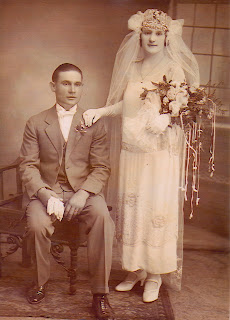
Photo: Mike and Mary on their wedding day, 1925.