Friday, February 25, 2011

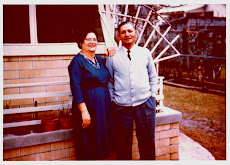
The Little House at 1804 East Howard Avenue


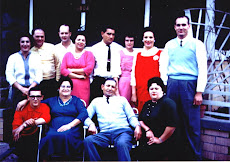
Photo: The family gathered outside 1804 East Howard Avenue, 1963. Front row from left: Uncle Michael Soljan, Nona (Mary Rosetti Soljan), Grandpa (Mato "Mike" Soljan), Aunt Marie (Soljan Sullivan). Back row from left: Mama (Antonia "Toni" Soljan Willis), Daddy (Jerry Willis), Uncle Steve (West), Aunt Dolores (Soljan West), Uncle Raymond (Soljan), Aunt Peggy (Gore Soljan), Aunt Selema (Soljan Castle), Uncle Russ (Castle).

Nona and Grandpa's house on East Howard was a simple 1940s wood frame and brick bungalow, fairly typical for the neighborhood, but it was the most wonderful place in the world to me.

When we camped out in the darkened living room to watch TV, the lamp, shaped like a covered wagon with a team of horses galloping across the the top of the TV set, cast a reassuring ruddy glow.

From opposite corners of the room, studio portraits of my Aunt Marie and Uncle Michael -- she in a teased bouffant with spit curls and a black velvet shoulder drape, he in studious horn rims and graduation cap and gown -- smiled down like beatific angels. The living room furniture was always draped with crocheted afghans, sheets and other fabric to protect it from daily use, except on holidays and other "good" occasions when company was expected.

The dining room was full even when empty of food. The sideboard was taken up by exotic Oriental figure vases and decanters brimming with green colored water -- a decorating fad that no one seemed to realize had become passe. The wall next to the kitchen door was dominated by grandchildren's photos arranged like a family tree. I think the grandparents needed it to keep track of which kid belonged to whom. The corner built-ins burst with cut glass, candy dishes figurines and souvenirs from Alaska, Germany and Bellingham Washington.


The siblings gather in the dining room. This photo was taken sometime after Camille, probably in the mid 1970s. Seated: Uncle Raymond and Aunt Dolores. Standing from left: Uncle Michael, Aunt Selema, Aunt Marie and Mama.

On frosty winter nights, nothing felt better than coming in out of wind and standing on the floor furnace grate until our stockinged soles couldn't take it anymore.

A popular kid hang-out was the front guest room with its "good" lavender flowered bed spread that we grandchildren sat on at the risk of getting our guzicas (pronounced guh zitz ahs) beaten. I swear Nona could hear a squeaky bed spring from around the block.

One couldn't help but feel safe from every possible bogeyman when sleeping in that house. Crucifixes hung in every bedroom; dried palm fronds and prayer cards were tucked into the edges of bureau mirrors (the tops were always dressed with frilly hand-made doilies); jars of holy water rested on every bedside table.

For extra insurance, a framed dime store print of the Guardian Angel oversaw our slumbers, just as did in every bedroom on the Point.

The guest bedroom had a cedar chest filled with sheets, embroidered pillow cases and, lacy frilled doilies -- all starched, ironed and neatly folded for the next use.

The well-worn, soft, pilled flannel shirts in Grandpa's closet were redolent of tobacco and Old Spice cologne. At least he wore the dime store cologne we dutifully delivered as dual Christmas/birthday presents each December. On Nona's bureau, a collection of barely used Avon bottles jockied for space with the cheap plastic religious figurines that we sold for parochial school fundraisers.

As in any Point home, the kitchen was the heart of Mike and Mary's with its Barq's bottle opener mounted to the wall, the lingering smells of drip coffee and grilled "boat bread" from breakfast and always a pot of soup, beans, daube or pasta i fazol on the stove, the multi-colored aluminum pitcher and tumbler set (although I confess I did not love the iced tea Nona served in it), and the slightly dented aluminum cake stand cover that usually contained a pound cake.

The screened porch was a great place to visit or people watch when we weren't walking on the old fishing bridge (but only as far as our mamas could see us from the house). We all fought over the gliders. The yard though small provided wonderful spots to play hide and seek. My cousin Joey could camouflage a team of five kids in that tiny yard so well that even their mamas would have a hard time finding them. Nona loved flowers and always kept her plant beds in beautiful condition.

Hurricane Camille took out much of what I loved in the original house -- which itself was a replacement for the house lost there in the Hurricane of 1947 -- but the somehow the portraits of Aunt Marie and Uncle Michael were still hanging in their corners; waves had crashed through the house, ruining everything else.

After my grandparents passed, Aunt Marie lived in the house for a while, then sold the property to a retired Catholic priest who bought it for himself, his mother and sister recently come from Vietnam to live in. Occasionally, my mother and aunts would stop by the old place to say hello.

Every morning when Father said Mass, he included blessings for all of us -- the many generations of Soljans sheltered and nourished for so many years in that kitchen in the little house at 1804 East Howard Avenue.

Beef and Baby Pasta Soup

I can't think of my grandparents' kitchen without thinking of soup, juha in Croatian. Beef soup with baby pastina was a favorite, especially when served with a heaping side plate of sauerkraut, boiled potatoes and mustard, pickled onions and sweet gherkins. Nona always made this with large piece of bone-in chuck. I find that beef today just doesn't taste as "beefy" as it used to and doesn't make a good beefy broth. If you find your cheaper cut of meat just ain't making the broth, substitute canned beef broth for some or all of the water in the recipe. When I made this after Christmas with the remnants of a standing holiday rib roast (with the bones still in), the soup tasted similar to what I remember. But I don't recommend buying a rib roast just to make the soup (unless your name is Rockefeller).

2-3 stalks of celery, diced

1 large onion, peeled and diced

3-4 potatoes, cut in large-ish chunks (you may one to dice one, but you want the chunks to dip into the mustard later)

3 -4 carrots, peeled and diced

1 large can whole tomatoes

2 1/2 quarts of cold water or canned beef broth.

Approx. 8-oz package of small pasta (I like the baby pastina beads, but use whatever type of pasta you like).

Place meat and water and broth in a large soup pot. Add salt to taste (about 1 tablespoon). let come to a boil. Skim off foam and boil until the meat stops foaming. Add celery, onions, potatoes, carrots and tomatoes. Boil until meat is tender. Remove meat. Add pasta. Cook until pasta is tender.

Sunday, February 13, 2011

The Kitchen At the Old Slavonian Lodge, 1956

Now here's a blast from the past. Who knows what they were making? My guess is pusharates. Yes, that's my nona, Mary Rosetti Soljan, holding out the plate in the front row. Does anyone know who the four "unknowns" are in the photo? Charles Sullivan, archivist for Mississippi Gulf Coast Community College, who kindly let me repost the photo here, wants to know. This is to be one of the photos in an upcoming book that will be published by the college.

Photo from Mississippi Gulf Coast Community College, C.C. "Tex" Hamill Down South Magazine Collection

Thursday, January 27, 2011

It Ain't Fancy But It Sure Is Good

Some of my favorite dishes fall into what is now popularly known as "rustic" (ie: peasant) cuisine: Loaves-and -fishes-feeds-as-many-people-as-it-needs-to recipes that can be made cheaply ( or could back in the day ) using fresh ingredients from the garden, the sea, the market place.

While rustic food has gone upscale these days, you can still find it in its simplest (and I think best) form in hole-in-the wall osteria and trattorias in Venice's back alleys or just about anywhere in the Dalmatian region of Croatia. Often it's a big plate of spicy shrimp spaghetti with crusty bread on the side, a carafe of no-name house wine, with a simple custard dressed in honey for dessert. This type of food was often seen on the tables (and out on the boats) of Point Cadet.

What makes Venice's (and Dalmatia's) rustic food different are the exotic spices they use in their tomato gravy. Yes, oregano and basil grow in profusion in kitchen gardens and window boxes here as they do all over Italy, but that je ne sais quois piquancy in their shrimp spaghetti may well come from shreds of lemon peel, hot peppers, strands of saffron, freshly ground nutmeg or even a pinch or two of cinnamon.

After all that spice you want something cool for dessert to cleanse the palate and temper the heat. Gelato is my dessert of choice, followed closely by panna cotta, a simple custard often dressed simply with berries in season or, as in this case, a drizzle of honey. If you want to make it extra-special, toast a few hazelnuts, chop them and sprinkle on top.


Spaghetti With Shrimp and Tomato Sauce*


1 lb of diced bacon or pancetta

3-4 large onions chopped

1/2 head of garlic chopped

1 cup minced flat-leaf parsley

1 cup chopped celery

1 cup chopped green onions

2 cans tomato paste

1 can Ro-Tel tomatoes

2 strips of lemon peel, chopped fine

3-4 lbs of shrimp, peeled

1/2 teaspoon cinnamon

1 T sugar

salt and pepper to taste.


1. Fry the bacon or pancetta in a skillet until crisp. Drain on paper towels.

2. Saute onions in the bacon drippings over medium heat until golden.

3. Add in tomato paste and stir until mixture is brown, but not burnt.

4. Add tomatoes, cinnamon and salt. Stir well, scraping the sides and bottom of the pan with a wooden spoon. Simmer for 45 minutes.

5. Add parsley, celery, green onions and lemon rind. stir well.

6. Add the bacon and garlic. Stir and simmer for 30 more minutes.

7. Add 1 cup of water, stirring constantly.

8. Cook shrimp separately in boiling water just until pink (about 3 minutes). Drain shrimp and add to the tomato mixture and continue simmering for another hour. Stir occasionally to keep the mixture from sticking.

9. Remove from heat and let cool and refrigerate. After grease has congealed, spoon off. Reheat before serving over cooked drained pasta of your choice. This may also be served over rice.

* There are several variations on this dish:

1.) Add sliced smoked sausage and/or diced ham to the recipe at Step 2. Saute in the bacon drippings and remove before adding the onions, then add back to the pot with the bacon and garlic in Step 6.

2.) Substitute 3 pints of shucked oysters for the shrimp. Parboil the oysters separately until the edges curl and drain before adding to the gravy.

Wednesday, January 12, 2011

Sniffles for the New Year

Happy New Year! I hope everyone's holidays were pleasant. I truly enjoyed mine, but, as usual, I was ready for them to be over when they ended.

I started 2011 off with a horrendous head cold which has now worked its way into my chest

My mama used to say, "Be careful of what you get into on New Year's Day because that's how you'll spend every day for the rest of the year."

I think she was right (and she just loved being right). This crud gives every indication of keeping me phlegm-ridden at least until spring. Lovely.

Fortunately, when my mother handed down aphorisms, she also handed down some recipes and remedies, at least one of which is helping with my current situation.

There weren't too many illnesses that Mama felt couldn't be helped (or warded off altogether) with a hot milk toddy -- a mixture of egg yolk, sugar, hot milk and a little vanilla (or whiskey for adults). It's like hot egg nog.

Even if you're not sick, it's a great way to cope with the chill of freezing January night like tonight.

And if I'm destined to drink one of these every night of 2011, well, I'm sure there are worse ways to while away an entire year!

Hot Milk Toddy

1 egg yolk
1 teaspoon sugar
Hot milk
1 tsp of whiskey or vanilla

In a coffee cup or mug, stir and egg yolk and sugar together until thick and lemon-colored. Slowly add the hot (but not scalding) milk whisking with the egg to prevent it from cooking on the spot. Add whiskey or vanilla. Add a sprinkling of nutmeg if desired (my touch).

Monday, December 20, 2010

Christmas Time in the City


Nona's favorite Christmas song was "Silver Bells." When I was a little girl, I thought "the city" in the song was New Orleans. It was the biggest (and only real) city I knew and my favorite place on Earth -- especially at Christmas.

Some four decades later, I've traveled much farther to much bigger cities. But New Orleans still is most dear to my heart -- well, except maybe for Paris.

My most treasured New Orleans memories date from December 1968 when we lived in the CBD.

My father was then the food and beverage director for Kolb's restaurant on St. Charles, a New Orleans institution, and the lunch spot for the city's downtown businessmen and shoppers. We lived upstairs on the third floor.

That old building was a den of curiosities, the type any eight-year-old dreams of exploring. Though the restaurant sold as much remoulade and red snapper as it did schnitzel and bratworst, the vibe was definitely Old Bavarian with a pulley style fan system operated by a giant Ludwig, a glass case filled with vintage beer steins and a china cabinet of delicate Bavarian china figurines, including an 18th century card game and a young courting couple.

But it was the restaurant's downtown setting that really provided the Christmastime magic that helped me forget that I didn't live in a house with a yard in a neighborhood full of kids.

In addition to the wonderful Mr. Bingle marionette shows and toy department at Maison Blanche department store on Canal Street, there were the ornate window displays at MB's rival , D. H. Holmes, the equal of any I've seen in New York or Paris.

That year, one window recreated an animated London Christmas straight out of Dickens, complete with an elderly lady roasting chestnuts, a roguish street urchin picking pockets and a Gothic cathedral that swung open its doors to reveal a golden Nativity scene against a red velvet back drop.

In the opposing window, opulent masked 18th century revelers garbed in pale blue, white and silver brocade, satin and fur, promenaded endlessly through arched white columns in a recreation of a Venetian Twelfth Night Ball.

A giant Santa Claus graced the facade of the downtown Sears at Common and Baronne where I jonesed over a jewelry box shaped like a Swiss chalet. A windmill wound up the music box to make the little ballerina inside twirl to the tinkling melody of "Fascination." A secret velvet-lined drawer under the windmill was the perfect place to hide my only piece of "real" jewelry, a birthstone ring.


On Sunday mornings, my mother and I attended eight o'clock Mass at the Jesuit Church of the Immaculate Conception on Baronne and afterward peeked in at the infamous lobby of the Roosevelt Hotel, then officially called the Fairmont though everyone still called it the Roosevelt.

We shopped for Christmas treats at the only grocery store near us -- the tiny A&P in the French Quarter, and in spite of the winter chill, enjoyed chocolate or strawberry sodas at the Walgreen's lunch counter.

While the rest of New Orleans headed to Kolb's after a busy day of shopping, our favorite downtown dining spot was the old Morrison's cafeteria on Gravier, the most beautiful cafeteria dining room I have ever seen. It was like eating in the square in Old Mexico with Spanish tiled floors, a twinkling "starlit" sky, and the facade of an old tiled-roof village with grille-work balconies and candlelit windows. I believe there was even a fountain.

We moved from New Orleans early in 1969, and though I have been back to the city many, many times since then, until this past weekend, I had never been back at Christmas time.

Most of my old haunts -- Maison Blanche, D. H. Holmes, the downtown Sears, Kolbs and the Morrison's ain't dere no mo'.


However, our little A&P, little changed, still operates down in the Quarter as Rouse's. The Fairmont is now officially restored to its former glory and called the Roosevelt once more. Its Christmas lobby is still a treat to behold. Across the street, the Jesuit church has also been spiffed up. The Walgreens, too, still stands, and for all I know still sells the world's best chocolate sodas.

However, these days, my shopping break libation of choice is a Sazerac in the Roosevelt's Sazerac Bar.


Turtle Soup

Perhaps Kolb's most beloved dish was their turtle soup. I remember one salesman ordered a big bowl of it every time he made a sales call and bought a gallon to take home. I haven't been able to find Kolb's recipe, but here's an authentic Creole turtle soup recipe from the blog Nola Cuisine

Sunday, December 12, 2010

The Feast of St. Lucy

Tomorrow is the Feast of St. Lucy, one of the two December celebrations that helped children growing up in Croatian households on Point Cadet take the edge off waiting for Christmas to arrive.

Like the Feast of St. Nicholas which is celebrated on Dec. 6 (read my St. Nicholas post here). St. Lucy's day is a relatively simple, yet much anticipated, occasion honoring one of Europe's most beloved virgin martyrs.

Sveta Lucia, as we called her, lived in Sicily during the late third century, early fourth century. Despite the Roman emperor Diocletian's ban on Christianity, Lucy converted after her prayers to God apparently cured her mother of a bleeding disorder. Lucy pledged to stay chaste and devote her life to Christian acts rather than marry the rich pagan to whom she was betrothed.

Her would-be suitor was so incensed by her rejection, he turned her in to the authorities for bringing food and drink to Christians hiding in caves and tunnels (she allegedly lit her way through the dark with a candle-studded wreath on her head)

After attempts to drag Lucy to a brothel and force her into a life of prostitution failed, as did efforts to burn her at the stake, her frustrated captors finally gouged out her eyes and stabbed her through the neck with a sword.

She was canonized by the Catholic church and today is best known as the patron saint of the blind.

Her feast day is widely celebrated in Sicily, Northern Italy, Croatia, Bosnia as well as Sweden, Finland, Norway and Denmark and several other European countries. Though Scandinavia today is largely Protestant, natives of these countries have loved Lucy ever since Christian missionaries convinced them she was a worthy substitute for the Norse goddess Freya in 1000 AD. Many of Scandinavia's traditional St. Lucy customs of today are actually ancient Norse traditions reattached to our girl Lucy.

Families in Hungary and Croatia sow wheat seeds on the Feast of St. Lucy (or sometimes on the Feast of St. Barbara on Dec. 4) which sprout by Christmas Day and are placed near the Nativity creche. My family never did this. I think this was more of a northern Croatian custom.

My family's St. Lucy's day celebrations unfolded much as they do in northern Italy where Santa Lucia delivers treats to children on the back of a donkey. We left out a bowl with carrots and lettuce for the donkey. St. Lucy left the bowl filled with candy -- and what candy -- fancy imported treats filled with jellies, liqueurs and flavored creams, molded into fantastic shapes and wrapped in beautiful foils.

We also lit candles in a tribute to St. Lucy's symbolic association with the Feast of the Lights -- lighting the way through the darkness of Advent to the joy of Christmas.

There are many regional recipes associated with St. Lucy Day celebrations -- hot buns in Sweden, cuccia, a kind of porridge-y dessert, or biscotti in Sicily. I don't remember my mother making a specific St. Lucy Day treat, but if I were to pick a traditional recipe to celebrate the day, it would be biscotti (also called biscutine) or perhaps this Venetian frico, fried cheese wedges

Santa Lucia Frico (Fried Cheese Wedges)Approximately 3-4 oz. shredded or grated hard cheese depending on the size of the skillet. Parmesan, Machengo Romano or cheddar work best. Semi-soft cheeses like mozzarella and Monterey Jack also work but will make a chewier frico. Very soft cheeses like brie or Camembert will not work and should not be used.

Spread the cheese in a thin, even layer in a 12" non-stick skillet. Some cheese varieties will require more cheese than others to completely cover the bottom of the skillet.

Place the skillet over medium heat and cook until the cheese releases all of its moisture and looks oily and bubbly over its entire surface. The cheese will melt together and form one large cheese pancake.

Use a spatula to lift one edge of the frico - the bottom should be well browned and the cheese should hold together firmly. It shouldn't be stringy or goopy.

Flip the frico and brown the other side for a minute or two, then remove from the pan and place on paper towels to drain. It will firm up and become very crisp as it cools.

Cut into wedges and serve.

Friday, December 3, 2010

Jingle, Jangle, Jingle ... Here Comes Mr. Bingle!


If you grew up in what is now known as "Who Dat Nation" (ie: New Orleans area and the Mississippi Coast) your Christmas included Mr. Bingle as surely as it included pusharates, fig roll, Christmas Eve gumbo or oyster dressing. The little snowman with holly wings and an ice cream cone hat remains so beloved by folks of a certain age, that sometimes it's easy to forget that he was just once just a marketing gimmick for Maison Blanche, one of the late, great New Orleans department stores.

When my daddy loaded up the Chevy Impala and took us on our annual Christmas shopping trip to downtown New Orleans (he loved the hustle and bustle of the city this time of year), the day was not complete without a stop by Maison Blanche's Canal Street window to await the raising of the red velvet curtain on the Mr. Bingle marionette show. Then you went upstairs, browsed the toy department, a Bingleland extravaganza with elaborate toy displays and Bingle dioramas, and had your picture taken with Santa Claus.

Of course, we didn't have to go to New Orleans to see Mr. Bingle. In Biloxi, if you had a good antenna, you could pick up WDSU-TV, one of the local New Orleans TV stations, and get the televised 15-minute Mr. Bingle show, which was part of their midday show, right in your living room. Afterwards, we'd walk around imitating Mr. Bingle's high-pitched voice and singing his little jingle -- which would drive the folks crazy -- all day long. (I have a theory that Mr. Bingle and Mr. Bill from Saturday Night Live, were twins separated at birth. Strong resemblance, same voice. You decide.)

Sadly, for better or for worse, times do change. Maison Blanche was sold a few times, most recently to Dillards, and the flagship store closed in the late 1990s.* I truly believe that in a few years no matter where you go in the world there will be only Dillards and Belks department stores, Regions banks and CVS drugstores. And the world will be a much lesser place.

It is a testament to the New Orleans community, so famously resistent to change, and their lawyers, most of whom were raised on Mr. Bingle, that the sales contracts always contained a "Bingle clause" that covered the legal rights to Mr. Bingle.

Mr. Bingle survived. Thank God for those Sazerac-sipping lawyers in their seersucker suits!

Every year at Christmas time, you can still buy a stuffed Mr. Bingle doll, Christmas ornament or other memorabilia, at a handful of Dillards stores. And if one of these Dillards isn't in your neighborhood, you can always buy them online. This year's retro edition is on sale now through December 12!


If you don't know (or just don't remember), the Mr. Bingle back story, the folks at Dillards have provided an "official Mr. Bingle web site" with the little guy's history, some recipes and craft projects and even an audio clip to one of those shows. Click at your own risk. You won't be able to get that jingle out of your head for days.

For a more nostaglic, non-corporate take, on Mr. Bingle, visit the Mr. Bingle fan page where you can share your memories with other fans and collectors. This page is not affiliated with Dillards.

And if you're still feeling the need to share with other MB devotees, there is even a Mr. Bingle Facebook group page.

For more on the Mr. Bingle mystique, read this 2004 article about his never-ending appeal.

Bingle Food

Back in the day, after you'd done your shopping in downtown New Orleans, sat on Santa's lap and watched the Mr. Bingle show, you couldn't head back to Biloxi until you'd had chocolate or strawberry soda from the Walgreen's soda fountain -- and picked up a sack of jellied orange slices from the candy counter -- and a plateful of hot beignets, loaded down with powdered sugar from Cafe du Monde.

If this little trip down Memory Lane is making you nostalgic, and you don't have time for a holiday road trip to New Orleans, you can fake it using one of those packaged Cafe du Monde mixes almost every grocery store sells. Or you can make them from scratch using this Paula Deen recipe or the one on the Mr. Bingle web site.

If you're more of a Rice Krispies treat fan, you might prefer to make Mr. Bingles from one of the (now out of print) Mr. Bingle cookbooks.

* The New Orleans Ritz-Carlton hotel stands in the former Maison Blanche location today.